Odysseus: When a Community Rebuilds the SaaS Stack
Businesses have spent the past decade adding software subscriptions.
One platform for AI chat. Another for research. Another for documents, automation, email management, internal knowledge and task tracking.
The result is often an expensive and fragmented collection of tools that do not communicate particularly well.
Okta’s 2025 data found that the average number of applications used by its customers had reached 101. Zylo separately reported average SaaS expenditure of $4,830 per employee annually, illustrating how quickly individual subscriptions can become a major operating expense.
Odysseus offers a glimpse of a different model.
The Odysseus self-hosted AI workspace
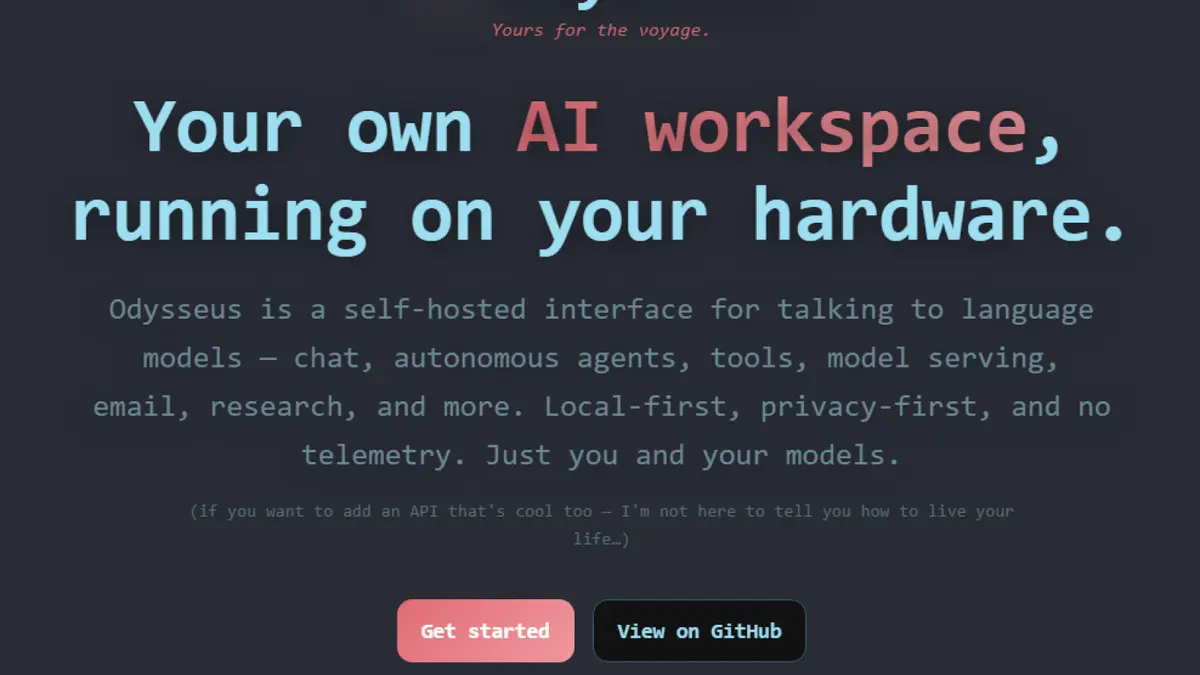
Odysseus brings local models, agents, research, documents and business tools into one self-hosted interface.
What is Odysseus?
Odysseus is an open-source, self-hosted AI workspace designed to provide an experience similar to ChatGPT or Claude while running on infrastructure controlled by the user.
The platform combines AI conversations, autonomous agents, document editing, deep research, email, notes, calendar functions, memory and local model management within one environment.
What makes the project particularly interesting is how it was created.
PewDiePie brought the initial attention, technical curiosity and audience. Developers and contributors gathering around the project have helped turn that idea into a broader suite of practical tools.
It is a strong example of what can happen when an online community moves beyond discussing technology and starts building it.
A suite of tools that could replace multiple subscriptions
The value of Odysseus is not simply that it provides another chatbot.
Its value comes from consolidation.
A business could potentially use one internal environment for:
- AI conversations and drafting
- Research and source analysis
- Document editing
- Internal knowledge retrieval
- Email assistance
- Model comparison
- Workflow automation
- Locally hosted AI models
Not every SaaS product can or should be replaced. Specialist accounting, CRM and regulated industry platforms will still have their place.
However, many modern AI products are effectively different interfaces built around similar underlying models. Businesses may be paying several providers for overlapping functionality.
That matters because enterprise spending on generative AI reached an estimated $37 billion in 2025, up from $11.5 billion in 2024. Menlo Ventures found that the largest portion of that expenditure went towards user-facing AI applications rather than the underlying models and infrastructure.
Enterprise generative AI spending increased from $11.5 billion in 2024 to $37 billion in 2025
This is where open-source platforms become commercially interesting.
Instead of paying indefinitely for several interfaces, a company can begin assembling an internal suite of tools around open-source software, selected AI models and infrastructure it controls.
The savings will depend on the business, its hardware and the software being replaced. However, for organisations carrying multiple per-user subscriptions, even partial consolidation could remove thousands in recurring annual costs.
AI is democratising software ownership
Until recently, building a capable SaaS platform required a large development team, substantial funding and years of work.
AI-assisted development is lowering that barrier.
Smaller teams and open-source communities can now reproduce features that previously required an entire software company. They can then publish the code, allow others to improve it and give organisations the option to host it themselves.
Odysseus demonstrates how this changes the relationship people have with software.
Instead of permanently renting access to a closed platform, users can increasingly:
- Inspect the software
- Modify its behaviour
- Choose the models it uses
- Connect it to their own systems
- Host it on private infrastructure
- Retain greater control over its future
This is what the democratisation of software looks like in practice.
The important change is not that every SaaS business will disappear. It is that businesses increasingly have a choice between renting software and owning more of the systems on which they depend.
Data ownership is the larger opportunity
Cost reduction may attract attention, but data ownership is potentially more valuable.
When employees use multiple external AI products, company information may be processed across several third-party platforms.
That information can include contracts, procedures, customer records, internal correspondence, technical documentation and commercially sensitive knowledge.
Because Odysseus can be self-hosted and connected to local models, organisations can create workflows in which more of that information remains within infrastructure they control.
That does not make a deployment automatically secure.
IBM’s 2025 research placed the global average cost of a data breach at $4.4 million. It also found that 63% of surveyed organisations lacked AI governance policies, while 97% of organisations reporting an AI-related security incident lacked proper AI access controls.
IBM figures showing gaps in AI governance and access controls
The lesson is not simply to move everything onto a local server.
A private AI system still requires authentication, permissions, network protection, encrypted connections, backups, monitoring and clear rules about what agents can access or execute. The Odysseus project itself advises users to keep authentication enabled and avoid exposing model or service ports publicly.
The advantage of self-hosting is control—not the automatic removal of risk.
From experimenting with AI to owning an internal AI system
AI adoption is already widespread, but meaningful implementation remains difficult.
McKinsey’s 2025 survey found that 88% of respondents said their organisations regularly used AI in at least one business function, yet only around one-third had begun scaling their AI programmes.
The difference is integration.
Giving employees access to another chatbot is not the same as building an internal AI system connected to approved documents, business processes and clearly defined permissions.
Skills are another barrier. OECD research found that 50% of surveyed SMEs reported that employees lacked the skills needed to use generative AI, while fewer than 30% of SMEs already using it provided related employee training.
This creates an opportunity for businesses willing to move beyond isolated subscriptions.
An internal platform based around tools such as Odysseus could become a controlled interface for company knowledge, research, documents and automation—without automatically distributing business data across a growing list of external services.
Build a software stack you control
Odysseus represents something larger than one open-source project.
It shows that communities can now rebuild substantial parts of the modern SaaS stack, publish the result openly and give people the ability to own the software they depend on.
That could mean:
Fewer subscriptions.
Lower recurring costs.
Greater customisation.
Stronger data ownership.
At Auto-mate Consultants, we are pioneering this approach across Ireland and Northern Ireland, helping businesses assess which subscriptions could be consolidated and implementing private, self-hosted AI systems around their workflows and data.
Your business should be able to benefit from AI without surrendering control of the information that makes it valuable.
Send me a message or visit auto-mateconsultants.co.uk to discuss a private AI deployment.